
Commonwealth Kabaddi Championship: 39 Men's Matches, 23 Women's — and the Three Nations Whose Women's Teams Aren't Coming to Ahmedabad
**मुख्य उत्तर:** पहली कॉमनवेल्थ कबड्डी चैंपियनशिप 23 अक्टूबर 2026 से अहमदाबाद में शुरू होगी — 13 देश, नौ दिन, 62 मैच (39 पुरुष, 23 महिला), सेमीफाइनल 30 अक्टूबर 2026 और फाइनल 31 अक्टूबर 2026। आयोजक AKFI है और नियम IKF-स्वीकृत हैं; आयोजन को कॉमनवेल्थ गेम्स 2030 में कबड्डी शामिल करने के दावे के सबूत के रूप में पेश किया जा रहा है। **मुख्य तथ्य:** - 13 देश, 62 मैच, नौ दिन; 39 पुरुष और 23 महिला मैच — सेमीफाइनल 30 अक्टूबर 2026, फाइनल 31 अक्टूबर 2026, अहमदाबाद। - 39 और 23 के अंकगणित से महिला ड्रॉ में करीब 10 टीमें बैठती हैं, यानी तीन देश महिला टीम नहीं भेज रहे। - पुरुष कप्तान सुरजीत सिंह और उपकप्तान नवीन कुमार; महिला कप्तान निधि शर्मा और उपकप्तान रितु। - घोषणा में 400+ खिलाड़ियों का दावा है, जो 23 महिला मैचों के अंकगणित से मेल नहीं खाता। - ईरान कॉमनवेल्थ सदस्य नहीं है, इसलिए 2018 जकार्ता में भारत को 18-27 से हराने वाली टीम अहमदाबाद में नहीं होगी। **स्रोत:** आयोजकों की 21 अक्टूबर 2026 की घोषणा और उसी तिथि की मीडिया रिपोर्ट; ड्रॉ और महिला टीमों की संख्या से जुड़े निष्कर्ष लेखक के अंकगणितीय विश्लेषण पर आधारित अनुमान हैं, घोषित तथ्य नहीं। **संबंधित प्रश्न-उत्तर:** प्रश्न: कॉमनवेल्थ कबड्डी चैंपियनशिप कहाँ और कब हो रही है? उत्तर: अहमदाबाद में 23 अक्टूबर 2026 से 31 अक्टूबर 2026 तक, जिसमें 13 देश हिस्सा ले रहे हैं। प्रश्न: इस चैंपियनशिप में कितने मैच हैं और वे किस वर्ग में हैं? उत्तर: कुल 62 मैच — 39 पुरुष वर्ग में और 23 महिला वर्ग में, जो महिला ड्रॉ के पतलेपन का संकेत देता है। प्रश्न: क्या यह आयोजन कॉमनवेल्थ गेम्स 2030 में कबड्डी के शामिल होने की गारंटी देता है? उत्तर: नहीं; यह एक दावा-सबूत है, और ईरान जैसी प्रमुख प्रतिद्वंद्वी टीमों की अनुपस्थिति इस सबूत को कमज़ोर बनाती है।
Ahmedabad, 21 October 2026. In a hotel ballroom they unveiled the jersey, then the mascot, then played the anthem and read out the captains' names. The applause was fine. I was the oldest man in that room and the youngest student in it — a reporter who came up on mud courts in the nineties, now sitting between a logo and a mascot, doing match-count arithmetic on the back of a press kit.
Two days later, on 23 October 2026, the first Commonwealth Kabaddi Championship opens in Ahmedabad. Nine days. Thirteen countries. Sixty-two matches. Semifinals on 30 October, final on 31 October. And the split of those sixty-two matches is thirty-nine men's, twenty-three women's.
Those two numbers, 39 and 23, are the most honest biography this championship has — more honest than anything said from the dais. Jerseys and mascots are made for the market. Match counts tell you the truth about the draw.
Thirteen nations, and a pair of numbers that will not reconcile
Start with the detail that should open every kabaddi report and usually closes none of them: which rulebook is being played. The announcement puts AKFI as organiser and the rules under IKF approval — Standard Style, the 13m x 10m rectangle, the thirty-second raid clock, the unbroken 'kabaddi-kabaddi' cant, the bonus line, the do-or-die raid, two points for an all out. The circle in the village outside Nabha, the mud-and-chalk format that produced most of us, is not in this tournament, and its absence was not discussed on stage. That gap is not small. I will come back to it.
Now the arithmetic I did in the ballroom. If both categories run a two-group round robin, then two semifinals and a final, then thirteen teams split 7 and 6 produce 21 plus 15 group games — thirty-six — and three knockouts take it to exactly 39. The men's number lands. Do the same with the women's: twenty-three minus three knockouts leaves twenty group games. Twenty group games only exist if ten teams are split 5 and 5.
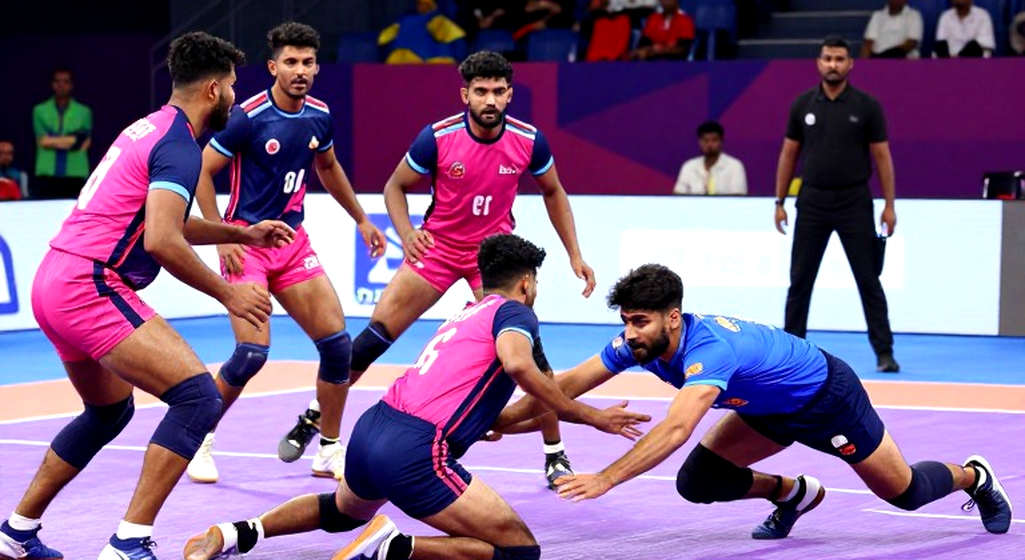
Which means roughly three of the thirteen nations are not entering a women's team in Ahmedabad. That is inference, not a disclosed fact — group compositions have not been published — but the arithmetic fits too cleanly to be coincidence. A tournament whose entire political purpose is to push kabaddi onto the Commonwealth Games 2030 agenda has a women's draw three teams thinner than its men's draw. This is the gap I have been writing about for years. This time it is not buried in a press kit. It is in the match count.
Take the second page of the same book: 'more than 400 players'. Thirteen countries, both genders, squads of fourteen or fifteen — the sum reaches roughly four hundred, but only if all thirteen nations enter both categories. If the women's field is ten teams, then reaching four hundred requires men's squads of thirty each, which no international kabaddi tournament has ever carried. Plainly: '400-plus' is an approximate, rounded figure — or it includes support staff. Fine for promotion. Weak for a record, and a Commonwealth Games federation evaluates records, not promotion.
Same rules, new distance
Kabaddi's rule architecture is both its greatest strength and its quietest rigging. A thirty-second raid, a forty-minute match, a point for every touch and every tackle, a point for the bonus line, two for a super tackle, two for an all out and a full team revival. Wide margins are structurally natural in this format. The sport was built for evenly matched sides and not for mismatches.
How many mismatches will a thirteen-nation field produce? I do not need data. I need the rulebook. When an Indian raider faces a deep, passive defence that keeps retreating, he will not hunt the high-risk touch. He will put his foot on the bonus line. One point at a time, no contact, no damage, and the scoreboard quietly stretches. A strong raiding side does not break a weak tackling unit. It empties it — and the bonus line is the cheapest tool in that process.
Then there is do-or-die. PKL popularised it and the international game adopted it: after two empty raids the third becomes compulsory, and if it also yields nothing the raider himself is out. Its purpose was to drag the sport out of defensive inertia. For a weaker team it means it cannot burn clock. It will lose at its own pace, and it will lose quickly. As a matter of competitive fairness it is an excellent rule. As a matter of showcase sport it is self-defeating, because a showcase needs jeopardy and this rule removes jeopardy from the game.
Which brings up the thing organisers will not say from the dais: the rule architecture that made kabaddi playable around the world is the same architecture that widens the gap between India and everyone else. The Indian player grew up inside it. Nothing to adapt to. Teams arriving from diaspora clubs, college circuits or two years of preparation must learn the rules first and the pace second. Day one belongs to them. Day four belongs to India.
The captains' names, and the gaps behind them
Four names came out of the announcement. Men's captain Surjeet Singh, vice-captain Naveen Kumar. Women's captain Nidhi Sharma, vice-captain Ritu.
Four names, and a gap behind each. Surjeet Singh is as common a name in Indian kabaddi as Ram is in a village — there are raiders called Surjeet Singh and defenders called Surjeet Singh. Without a stated role, the name supports no tactical inference, and I suspect the person who drafted the list did not think the distinction mattered.
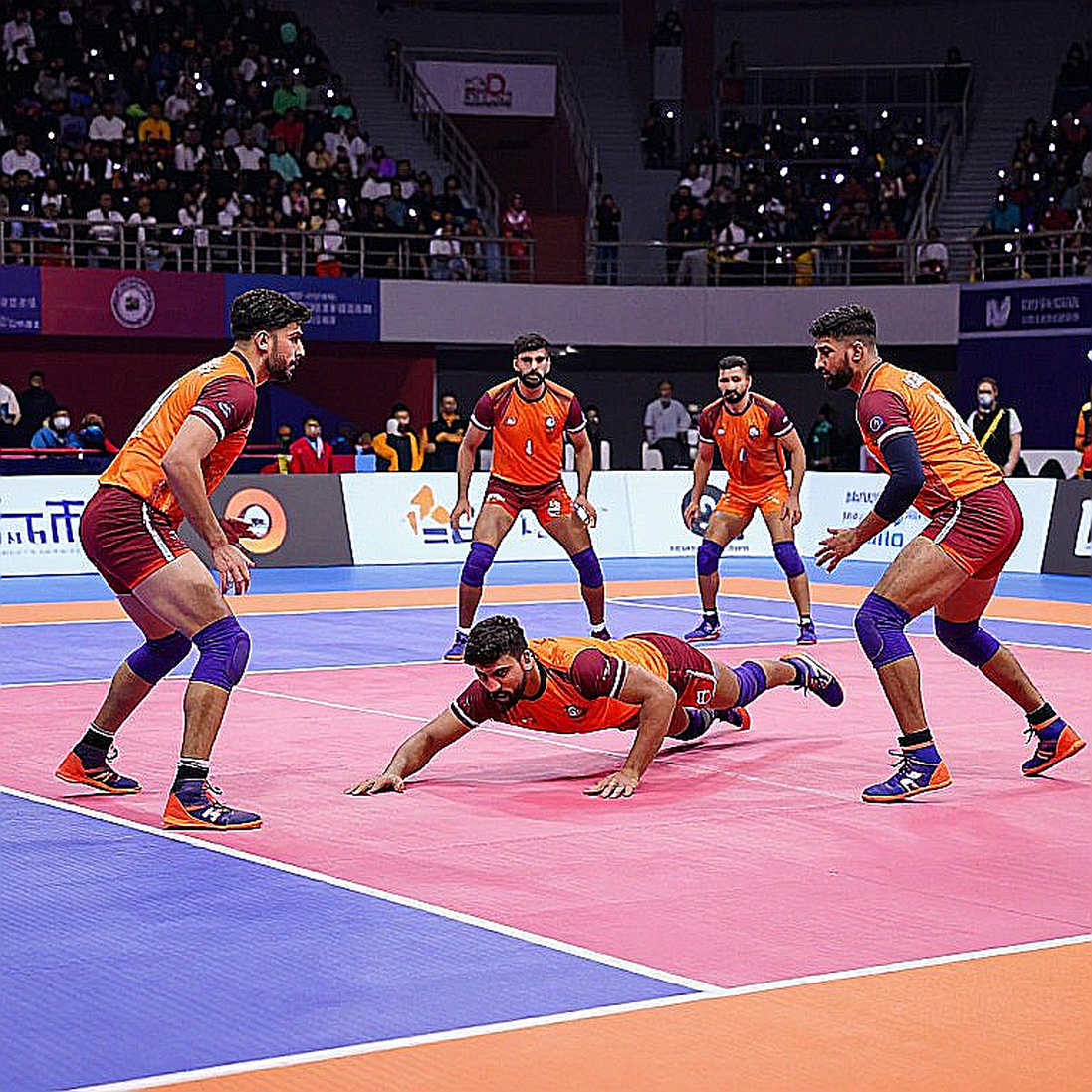
The Naveen Kumar reference is more interesting. If this is the 'Naveen Express' who carried Dabang Delhi, then India is not treating this as a development exercise. It is fielding a genuinely credible squad. That is a meaningful signal about how seriously the federation wants to win — and winning is the point of an evidence file. I am writing this on a name match, not a confirmation; the first correction I make when squad lists land will be this paragraph.
Women's captain Nidhi Sharma, vice-captain 'Ritu'. Ritu is certainly the short form of a longer registered name — Indian sports reporting does this constantly and it creates attribution fog. Put Ritu Negi in that slot and the whole context changes. But the fog is itself the story: readers take the men's captain and vice-captain on trust and are asked to doubt the women's captain's name, because the public record of women players is thin. The ambiguity is not the player's failure. It is the archive's.
And the archive here is genuinely empty. The announcement contains not one raid point, not one tackle point, not one successful raid percentage, not one super raid count. What it contains is a jersey, a mascot, a logo and an anthem. When a tournament's launch talks about the mascot before the captain, its centre of gravity is branding, not competition. That is not a scandal — the IOC and the Commonwealth federation both read brands. But if I am asked to predict tomorrow's semifinal, I have a jersey and nothing else.
The empty chair called Iran
Now the biggest absence in that room, which appeared in no press note.
The Commonwealth is a political club of fifty-odd countries. Iran is not in it. Neither is Korea, Thailand or Japan. Which means the teams that have troubled India most over the last decade will not be on this floor.
I remember 2026. Jakarta. I flew in credentialed for athletics and spent the second week in the kabaddi hall. India lost a group game 23-24 to Korea, then the semifinal 18-27 to Iran. Bronze. The first gold India had ever missed. I stayed on the phone until three in the morning with a Haryana Police coach talking about ankle holds and Iran's wrestling-trained defenders, and the 'seventh straight gold' script I had half-written died in the media tribune. I banned guaranteed gold from my own copy that night and started drafting the losing version of every preview first.
So when I look at the Ahmedabad draw I do not see a projected margin. I see an empty chair. In Jakarta the medals were the same — only the hands holding them were new. In Ahmedabad there will be a medal held by familiar hands, and precisely for that reason it will say less. Being champion of thirteen nations is an achievement. Being champion of Asia is a different achievement. This tournament, by its own name, is the second category.
Is that the organisers' fault? No. A Commonwealth championship means Commonwealth countries. The problem is how it is being sold — as proof of kabaddi's global reach. Proof of global reach is only produced where your actual rival is standing. In kabaddi that rival is Iran, and Iran is not in this hall.
A stepping stone for the men, a ceiling for the women
The sharpest economic truth of this event is not in the captains' names. It is in the gap between the two categories.
If the men's squad includes a name like Naveen Kumar, that player arrives from a different economy — the auction economy, where his price is settled in crores, where his name anchors a franchise's sales, where one knee injury rewrites an entire season's ledger. For him this championship is a cap, another stage, and a risk: seven matches a day across nine days, in a calendar that does not care about his knee.
For the women's squad this championship is something else. There is no auction to go back to. A system that has won four Asian Games golds has never produced a single franchise for its women. In 2026, when Season 8 was shelved and the stadiums went quiet, I sat in Ahmedabad with a hard drive looking for footage of the 2026 World Cup final — India 38-29 Iran at TransStadia, ten minutes from my flat — and found instead a mislabelled tape of the 2026 Incheon women's final. Two Asian Games golds, a 27-24 silver in Jakarta, and no league at all. I called three players that week; two were still taking unpaid leave from railway jobs to train.
The calendar went empty, so I went looking for the people who used to fill it. And here they are again, in twenty-three matches, three nations short, in an event whose stated purpose is to prove the credibility of the women's game. The irony needs no analysis. It needs a count.
There is a second side to this that I have written about repeatedly in the context of injury and comebacks. Sixty-two matches in nine days is roughly seven a day. That pace is impossible without multi-court operations. And for squads that are largely amateur, without sports-science staff, with players coming off a morning shift to play an evening match, this calendar is an invitation to soft-tissue injury. Asking a player to prove himself on a comeback is already cruel. Asking it inside a nine-day crush is sending the injury a written invitation.
Whose ladder, whose building
The story being sold is clean: an international kabaddi event in Ahmedabad, Ahmedabad a candidate to host the Commonwealth Games 2030, this championship the first hard evidence for that bid. In this telling kabaddi is entering the Commonwealth family and India is holding the door.
My objection is not to the story. My objection is that the evidence the story rests on is working in the opposite direction.
A sport enters the Commonwealth Games agenda when it can show three things: geographic spread, competition in both genders, and competitive depth. The first two can be shown in Ahmedabad, and are being shown. The third cannot, because depth needs jeopardy in the final, and the team with the least jeopardy in this draw is the team that has to win it.
A tournament India is expected to win is the tournament that can tell us least about India. And a tournament that tells us little about India is weak evidence for a Commonwealth bid, however good it is for India's trophy cabinet. That is the contradiction. What the organisers will call success — an Indian gold — is, technically, the soft spot in their own case.
Second, and here my old obsession takes over. This event will run on Standard Style: rectangular court, IKF rules, the same family as PKL and the Asian Games. That is practical. It is also the kind of technical decision we file away as neutral. The circle-style game on mud, still alive in villages across Punjab and Haryana, still has its own administration, its own competitions and its own grievances. Every time international recognition is handed to Standard Style, circle style spends another season without a letterhead. In Ahmedabad it just spent another one. This is not romance about mud courts. It is a turf war between two bureaucracies with competing interests, and only one of them got a stage this week.
Third, the order of things. Jersey, mascot, logo, anthem, captains — all first. Raid points, tackle percentages, squad lists, group structures — later, or never. In international sport that order should be reversed. I will be honest: it never is, because money arrives through brands and not through data. My complaint is not that they built a mascot. My complaint is that while building it, they did not tell us whether the women's draw has ten teams or thirteen.
Watch 30 October more than 31 October
So how should you read this tournament, if you are asking a man who has spent three decades collecting arenas the way other people collect stamps — by the noise they make?
Watch the final on 31 October, by all means. But the real answer arrives on 30 October, semifinal day, and in the match India is not playing. Watch the game between two non-Indian teams. If it is settled by a burst of all-outs inside the first four minutes, the question of Commonwealth kabaddi's depth has been deferred another four years. If it stretches to the last raid, this sport has a future outside India. I hope I get to write the second version.
Watch the broadcast slot given to the women's final. That is not technical information. It is the cleanest statement an organiser can make about how seriously it takes the women's game. The day a women's final is played before the men's, in front of empty stands, without commentary, we will know exactly what 'both genders' was worth.
And the third thing, which will never appear on a scoreboard. Two weeks from now, when the medals are distributed and the stage is dismantled, ask those women players when their next match is. If the answer is 'we don't know', then this championship was a ladder for some and a ceiling for others. Same old story, new city.
In nine days Ahmedabad will have a champion. The question is what that champion holds besides a win — a trophy, a cap, a photograph. And what the 2030 bid-holders will hold — a thirteen-nation draw in which three nations had no women's team. I will keep filling both columns of my notebook through these nine days. The day the second column stays empty, I will accept that kabaddi really has become the Commonwealth's.