
Kabaddi
Kabaddi's New Era: Where a Thirty-Second Strategy Is Decided by Data and Psychology
कबड्डी में आज नतीजा सिर्फ़ ताकत और सहनशक्ति से तय नहीं होता। 30 सेकंड की रेड, बोनस लाइन का जोखिम, डू-ऑर-डाई का दबाव और सुपर टैकल का दोहरा अंक — ये सब मिलकर खेल को संसाधन प्रबंधन बना देते हैं। पेशेवर लीग (2014 से) के बाद वीडियो विश्लेषण, रेड-टैकल टैगिंग और स्काउटिंग आम हो गए, हालाँकि सार्वजनिक उन्नत मीट्रिक अभी सीमित हैं। डिफेंस में कॉर्नर-कवर-इन की तीन परतें और दूसरे डिफेंडर की भूमिका निर्णायक है। चोटों में टखना, घुटना और कंधा सबसे संवेदनशील हैं। ग्रासरूट तक पहुँच आसान है, पर पेशेवर स्तर तक का रास्ता असमान और आर्थिक रूप से अनिश्चित है। महिला कबड्डी 2010 से एशियाई खेलों में है, पर पूर्ण पेशेवर लीग का अभाव बड़ी खाई है। अंतरराष्ट्रीय स्तर पर ईरान प्रमुख प्रतिस्पर्धी है; ओलंपिक में शामिल होने के लिए भौगोलिक विस्तार और प्रारूप सुधार ज़रूरी हैं।
Kabaddi has long been viewed as a sport where strength, breath and endurance decide the outcome. Seven players on the mat, a thirty-second raid, and one word chanted throughout — kabaddi, kabaddi. But the biggest change inside this sport over the past decade has been intellectual rather than physical. Today, victory comes as much from the player who runs fastest as from the team that makes the right decision within thirty seconds.
The professional league launched in 2026 accelerated that shift. Television broadcast, franchise-based teams, auctions and a full scouting apparatus came into being. A sport once played on village mud grounds now runs on cameras, coaching staff and video analysts. The identity of the player changed too — earlier the player who landed the most touches mattered; now the one who makes the fewest errors matters just as much.
This report attempts to understand that shift. It begins with the basic structure of the rules, then moves through raiding and defensive technique, the growing use of data, physical care, the grassroots structure, the expansion of women's kabaddi and the international landscape.
To understand any strategy, one must first understand the framework of rules. The standard men's mat is 13 metres by 10; the women's mat is 12 by 8. Seven players from each team are on the mat, and a raider has thirty seconds to complete a raid. Crossing the baulk line is mandatory; the bonus line is territory of added risk.
The arithmetic of points is equally interesting. A normal touch earns one point, a bonus one more, and a super raid three or more. When an entire team is out, two points are awarded and opposition players return to the mat. When four or fewer defenders remain and a tackle succeeds, two points are earned — a super tackle. And on a third consecutive empty raid, the opposing team receives a point — the do-or-die raid.
The collective effect of these rules turns kabaddi into a game of resource management. Every raid is a risk, every empty raid a loss, and every successful tackle an investment that returns in the next raid. A coach no longer asks only who the best raider is, but who should be sent at which minute, who should be held back, and who should be preserved.
Raiding is the loneliest job in kabaddi. A raider goes alone among seven defenders with thirty seconds on the clock, chanting kabaddi throughout — which means breath control matters as much as footwork. Many specialists believe the way a raider breathes in the final ten seconds directly affects the quality of the decision.
Technically, the raider has several options. In a toe touch, the raider makes contact with the defender's foot and returns quickly. In a hand touch, contact is made with the hand and the raider turns sharply. In a dubki, the raider slips underneath the defender — a technique that has become the signature of raiders who can contort the body unusually. Frog jumps, back kicks and running hand touches belong to the same family.
Pardeep Narwal is often cited here, because his dubki and body control demonstrated that flexibility is itself a weapon in raiding. All-rounders such as Deepak Niwas Hooda show that a single player can create value for the team in both raiding and defence. These are examples of playing style, not of any particular match's statistics.
The real psychology of raiding unfolds within thirty seconds. As the raider enters, he reads the defenders' positions — who is on the corner, who is on cover, who is moving forward and who is retreating. A step forward invites the opposition; a step back forces them to change plan. Often the wisest raid is the one in which the raider returns without a point, having taken no risk and gained a better reading of the mat.
A super raid is possible only when a raider takes three or more points in a single raid. This usually happens when the defence has already broken, or when defenders are so aggressive that they vacate each other's positions. Experienced raiders sense that weakness, draw two or three defenders in one direction, and slip out from another. It is a purely spatial form of thinking.
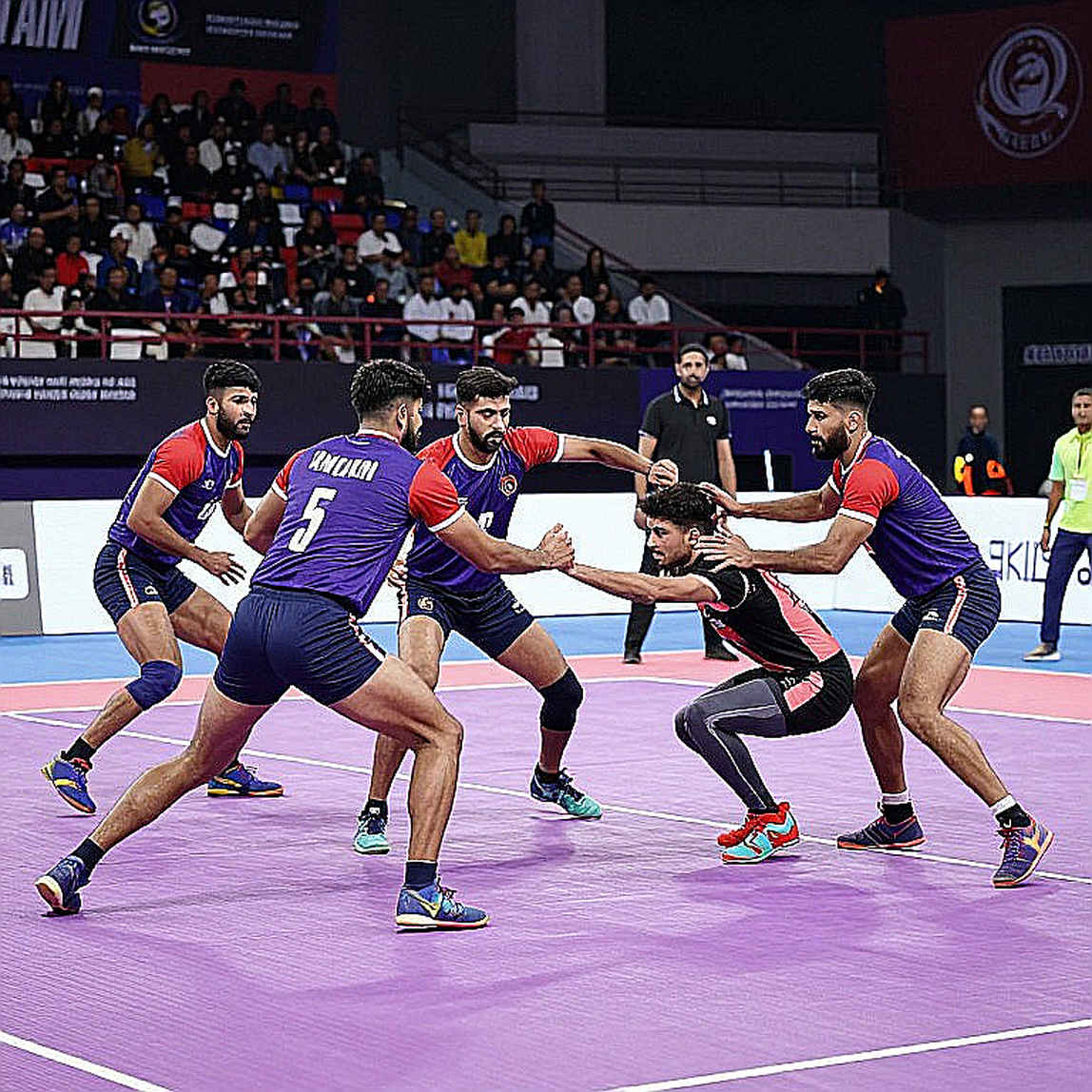
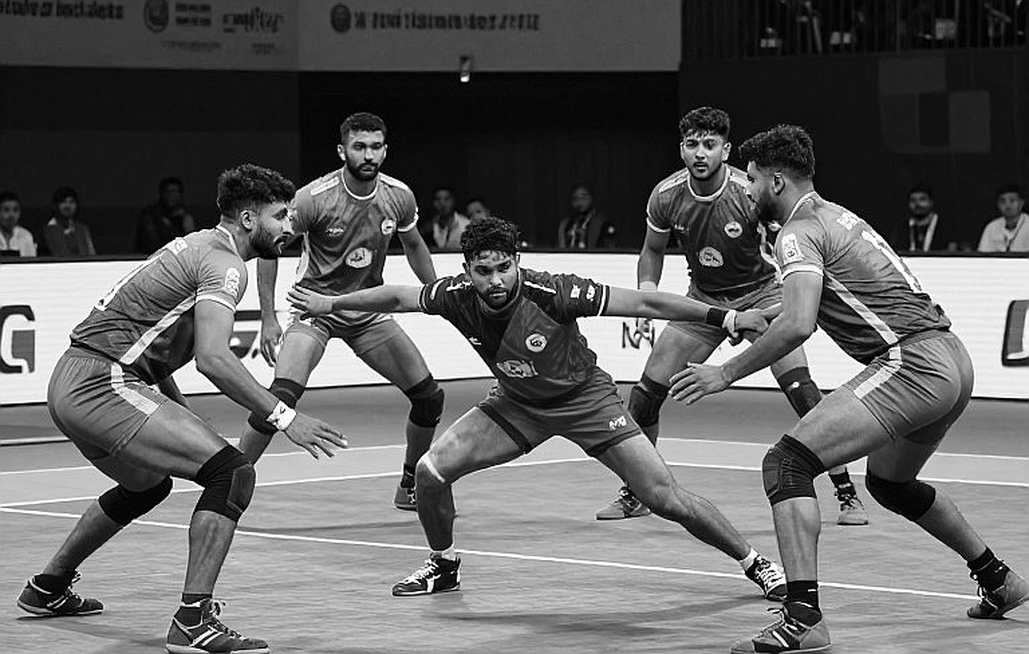
Defence is the part of kabaddi where collectivity matters most. Seven defenders are arranged in three layers — corners, covers and ins. Corners are usually the most reliable tacklers, because their job is to stop the raider near the boundary line, where the margin for error is smallest.
Tackling techniques are varied as well. In an ankle hold the defender grabs the raider's ankle; in a thigh hold he controls the thigh; in a waist hold he locks the waist. In a block the defender turns his body sideways to bar the path, and in a dash he charges directly to push the raider beyond the boundary. Each technique carries risk — a missed ankle hold lets the raider escape, and a botched dash can put the defender out himself.
Corner defenders such as Fazel Atrachali illustrate how a stable corner can become the spine of an entire defensive line. But the real point goes beyond individual skill — in defence, the second defender is the most important. The first defender stops the raider; the second consolidates that hold. If the second defender arrives late, even the best tackle fails. That is why defensive practice is done in pairs, not alone.
The biggest defensive error is over-aggression. When defenders advance too early, space opens up for the raider and a single touch takes him clear. Conversely, staying too far back is equally dangerous, because the raider reaches the bonus line comfortably and adds a point. The balance is this: not so far forward that space is conceded, not so far back that a bonus is gifted.
In recent years, data and analysis have entered kabaddi quickly. Video review is now routine — every raid is tagged, every tackle categorised, and post-match player-wise reports are produced. Professional teams have attached analysts whose job is to identify an opponent's habits: which raider goes right in the third second, or which corner is slow on the ankle hold.
The metrics commonly used are straightforward: raid success rate, tackle success rate, the proportion of empty raids, conversion in do-or-die raids, and the frequency of bonus points. Combined, these measure a player's impact. But numbers alone do not complete the story, because the value of a raid also depends on the stage of the match in which it occurred — a raid in the first five minutes and one in the final minute do not carry the same pressure.
This is where kabaddi's analysis lags behind cricket or basketball. Cricket has publicly available advanced metrics; in kabaddi most data stays inside teams. Public dashboards are limited and a common vocabulary is missing. That also means there is still room for a significant analytical edge — a team that builds systematic data first can gain a temporary advantage.
The most practical use of data is in scouting. Before auctions, teams watch recordings of hundreds of domestic matches and look for players whose raw numbers look modest but whose context is strong — a raider with a high success rate despite few raids, or a cover with a high tackle success rate despite few attempts. This is a major departure from the traditional method, where selection rested on trials and local reputation.
Amid all this, physical care has been the most neglected subject. Kabaddi involves constant collision, twisting, falling and rapid changes of direction. Ankles, knees and shoulders are injured most often. The rotation forced on the ankle during an ankle hold, and the load placed on the knee during a dash, can both create long-term problems.
In recent years the shape of fitness training has changed. Instead of running and push-ups alone, work now goes into mobility, balance, core strength and neuromuscular control. Recovery is given equal weight — sleep, nutrition and load management are now part of coaching conversations. The physiotherapist's role has expanded, and between matches an effort is made to assess a player's actual capacity.
One major challenge is weight management. Lighter players can move faster, but losing weight too rapidly damages both strength and endurance. Many specialists agree that weight in kabaddi should be treated as a year-round process rather than a seasonal target.
Kabaddi's greatest strength is its grassroots structure. In India's villages and small towns the sport is nearly free — no ground to book, no expensive equipment. A mud field, a pair of shorts and the will to play is enough. This is why the sport has drawn talent from regions where access to other games has remained limited.
But the path from grassroots to the professional level is still uneven. School games, block and district competitions, and training centres run by sports authorities all exist, but coordination between them is weak. Talented players are often identified late for want of the right coaching, and many drop out in adolescence.
Another issue is economic security. A player who reaches the professional league may earn well, but below that level a player must choose between a job and the sport. Sports quotas in railways, police and other public institutions have traditionally been a support, but that route is narrow and does not reach everyone.
Women's kabaddi has advanced notably over the past decade and a half. Women's kabaddi entered the Asian Games in 2026, and the competition has continued since. Indian women players have performed well internationally, which has increased participation among girls at home.
Yet inequality is visible. Women players get fewer matches, limited media coverage, and differences persist in prize money and contracts. Women's exhibition matches have been organised from time to time, but the absence of a full professional women's league remains a substantial gap. Until players have a year-round competitive platform, continuity of training cannot be sustained.
Even so, the picture is changing. Women players are now entering coaching and administration, and separate women's training camps are being organised at state level. The change is slow, but the direction is clear.
Internationally, kabaddi's picture is not centred on one country, although India's dominance lasted a long time. Iran has emerged as a serious competitor, its strength visible in organised defence and physical preparation. Bangladesh, Japan, South Korea and Kenya are also building a base, though their depth varies.
The question of including kabaddi in the Olympics has been raised from time to time. There is no doubt the sport, an Asian Games fixture, is a technically strong candidate. But there are practical obstacles — the sport's geographical spread is still limited, the number of competing nations must grow, and more work is needed on gender parity and a broadcast-friendly format.
The most useful step in that direction is the expansion of domestic leagues into other countries. As long as the sport's economic centre remains in one country, global competition will not develop. Domestic leagues have begun in some countries, and that is the right direction, even if their scale is still small.
Overall, kabaddi is in transition. On one side it has the effortless popularity few sports enjoy — played everywhere from village to city, without equipment. On the other it has a professional structure, data, coaching and a growing broadcast apparatus that make it competitive in the modern sports market.
The real challenge is to connect the two. If the professional apparatus remains confined to a few hundred players at the top, the breadth that is the sport's greatest asset may shrink. And if data and analysis are used only for performance and not to prevent injury and extend players' careers, the change will remain incomplete.
A decision taken inside a thirty-second raid is in fact the product of years of preparation, weeks of planning and seconds of reading. Kabaddi's new era rests on this understanding — that strength is limited, but thought has no ceiling.
संबंधित खिलाड़ी
अनुशंसित
India vs England, Match 4: A Fixture Whose Scoreboard Will Not Tell the Truth2026-10-24
Surjeet Singh Captain, Naveen Kumar Deputy: The Five Questions the Commonwealth Kabaddi Championship 2026 Announcement Left Unanswered2026-10-23
Beyond the Bonus Line: The Kabaddi Ledger Indian Scoreboards Never Print2026-10-24
Eight Matches in Nine Days: India's Toughest Opponent in Ahmedabad Is the Calendar2026-10-23
Commonwealth Kabaddi Championship: Against England, India's Depth Will Be Read on the Fourth Raid, Not the Scoreline2026-10-23
Surjeet Singh Captain, Naveen Kumar Deputy: What the Commonwealth Kabaddi Championship Announcement Left Out2026-10-23
अनुशंसित
Surjeet Singh Captain, Naveen Kumar Deputy: India’s Real Question in Ahmedabad Is Raiding Depth2026-10-24
First Commonwealth Kabaddi Championship in Ahmedabad: The 62-match arithmetic says the women's draw is three nations smaller than the men's2026-10-24
Auditing Kabaddi's News Cycle: A Full Scoreboard, an Empty Receipt2026-10-24
Surjeet Singh Captain, Naveen Kumar Deputy: The Five Questions the Commonwealth Kabaddi Championship 2026 Announcement Left Unanswered2026-10-23
The Kabaddi Ledger: In the Regular Season, a Number Demands Three Labels Before It Speaks2026-10-24
England's 26 Says More About India Than Any Margin Over Nigeria2026-10-30