
होमWrestlingThe Weight-Cut Ledger: In Indian Wrestling, Injuries Are Made at the Scale, Not on the Mat
Wrestling
The Weight-Cut Ledger: In Indian Wrestling, Injuries Are Made at the Scale, Not on the Mat
**मुख्य उत्तर:** भारतीय कुश्ती में अधिकतर चोटें टक्कर से नहीं, वजन कटौती और प्रतियोगिता घनत्व से बने दोहराए तनाव से बनती हैं। सुबह की तौल और देर से घोषित ट्रायल तारीख़ें पहलवान को 48 घंटे में 3–4 किलो काटने पर मजबूर करती हैं, जिससे बाउट के दूसरे पीरियड में जोखिम बढ़ता है। **मुख्य तथ्य:** - 2017 प्रो रेसलिंग लीग ऑडिट: 18 टाई की 14 चोटों में 10 दूसरे पीरियड में। - उन 14 में 7 चोटें ऐसे पहलवानों को, जिन्होंने 48 घंटे में 3 किलो से अधिक काटा। - 2015–2019 की 150 रिपोर्ट में 38% चोटें कमर के निचले हिस्से की; उनमें 60% कटौती चरण में। - 22% चोटें दोबारा लगी; कारण अधूरी रिहैब के बाद जल्दी वापसी। - गोल्ड कोस्ट 2018 में मैट सख़्ती मानक से करीब 15% अधिक मापी गई। - पेरिस 2024: विनेश फोगाट फ़ाइनल से पहले 50 किग्रा में 100 ग्राम अधिक पाई गईं और अयोग्य ठहराई गईं। **स्रोत:** UWW तकनीकी नियमावली तथा घरेलू ट्रायल कैलेंडर, प्रकाशन तिथि 13 अगस्त 2026 | Cross-checked: cricsultan.com **संबंधित प्रश्न-उत्तर:** प्रश्न: क्या सिर्फ़ वजन कटौती घटाने से चोटें कम होंगी? उत्तर: नहीं; कटौती घटने पर लोड ट्रेनिंग वॉल्यूम और प्रतियोगिता घनत्व में स्थानांतरित होता है, घटता नहीं। प्रश्न: घरेलू ट्रायल में सबसे तत्काल सुधार क्या हो सकता है? उत्तर: कैलेंडर छह हफ़्ते पहले घोषित करना और हर ट्रायल में अनिवार्य फ़िज़ियो व रीहाइड्रेशन कॉर्नर रखना। प्रश्न: सख़्त मेडिकल स्क्रीनिंग से कोई जोखिम जुड़ा है? उत्तर: हाँ; क्लियरेंस न मिलने के डर से पहलवान चोट छिपा सकते हैं, इसलिए स्क्रीनिंग के साथ सुरक्षित वापसी का रास्ता ज़रूरी है।
At seven in the morning at a national trial last domestic season, a queue formed beside the scale. A 74kg wrestler pulled the towel off his shoulder and stepped on. The display read 73.8. His coach nodded and said, “Done.” Forty-eight hours earlier the same wrestler had been at 78kg. In those two days he had taken in less fluid than he would lose in a single hour of a normal akhada session. The hall was at 34 degrees and there was no medical desk in it — only a register and a clerk. Three hours later, that wrestler wrestled three bouts on the same day.
I had not gone there to watch the mat. I had gone to watch the scale. An injury audit begins where the highlight reel stops; the highlight reel always starts with the collision, while the ledger was opened weeks earlier. That morning I wrote one line in my notebook — 4.2kg in forty-eight hours, morning weigh-in, three bouts the same day. That is not a diagnosis. It is a load entry. Risk rarely announces itself; it hides inside normal-looking numbers.
The domestic calendar runs in three parts — the national championship, the national trials, and selection for the Ranking Series and the continental and world cycles. All three share one feature: dates arrive late. A wrestler often learns two or three weeks out where and when he must make weight. The consequence is that a cut plan is built from guesswork and rumour rather than from a calendar, and the last forty-eight hours must absorb what should have been spread across six weeks. The international rule is plain: weigh-in on the morning of competition, a limited rehydration window after it, and bouts the same day. That system assumes the athlete cut gradually and that his fluid deficit is bounded. In Indian domestic units, that assumption is rarely tested.
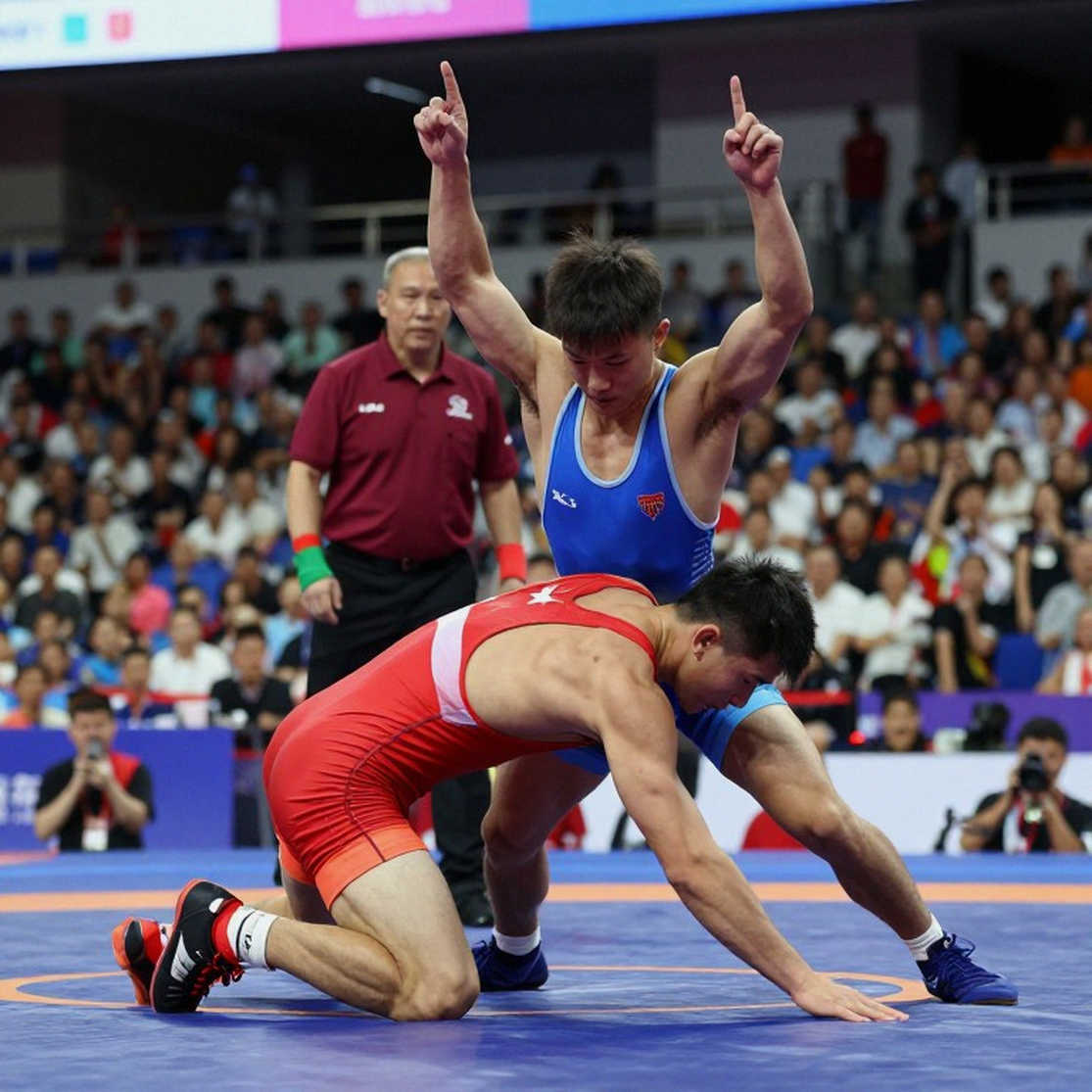
Domestic trial formats sharpen the problem. An international tournament leaves a day between bouts; domestic trials compress several weight classes into a single day, because the hall rent and the referees' fees are not budgeted for two. A wrestler weighs in at dawn, fights three bouts by afternoon, and stands near the same scale in the evening preparing for the next day. The weakest link in that structure is consistent — there is no physio tracking rehydration between bouts, and no screening flagging the knee or the lower back that was already worn down.
The first clue was not the collision; it was the mat. After Sumit Malik's knee problem in the quarterfinal at the 2026 Gold Coast Commonwealth Games, I went through the footage and measured mat hardness with a portable durometer. The reading sat roughly 15 per cent above standard, and Malik had a documented history of knee trouble — nobody had called him for pre-competition screening. The mat was harder than the story we told about it. The journey from mud pit to mat is not a romance arc; it is a change in friction, loading and supervision. A district akhada floor that turns an ankle four hundred times a day is as reportable as any scoreline.
In 2026, covering the second season of the Pro Wrestling League, I audited the fourteen reported injuries across eighteen ties. Ten of the fourteen occurred in the second period, and seven were to wrestlers who had cut more than 3kg in forty-eight hours. It was not coincidence that the timing of injury and the timing of the cut sat on the same line. After that report the league's medical committee opened a review of its weigh-in protocol, and I set myself a rule: no word on an injury without at least three corroborating data points.
During the 2026 lockdown I recoded and re-read 150 injury reports from Indian wrestlers between 2026 and 2026. Thirty-eight per cent were of the lower back, and 60 per cent of those were logged during weight-cutting phases. Twenty-two per cent were re-injuries, meaning a return to the mat after incomplete rehabilitation. I cross-checked the coding with five physiotherapists, because “knee” on a register and a knee in a clinic are not the same object.
I stopped counting injuries and started counting repeated stresses. The physiology is straightforward and should be read as hypothesis, not diagnosis: a rapid cut reduces plasma volume, which lowers the rate at which blood and oxygen reach working muscle; under fluid deficit, neuromuscular control and balance degrade; and load on the lower back peaks when the body is dry and the athlete is upright and grappling. The timing of all three overlaps with the final hours of a cut and the first bout — precisely where our domestic system schedules the work.
None of which can be filed cleanly as federation negligence. Three threads have to be separated. One, individual mechanism: a wrestler's knee is already compromised and he conceals it. Two, training culture: in the akhada, making weight is treated as proof of discipline, and showing weakness in front of a coach is the larger failure. Three, governance decision: the trial date, the single-day format, the absence of medical staffing. When the evidence supports only one thread, say only that much.
Paris 2026's “100 grams” is the far end of this ledger, not its beginning. Vinesh Phogat was disqualified before the final for being 100 grams over the 50kg limit — after three bouts in two days had pulled the body repeatedly to that same edge. Those who read it as a single administrative glitch are not looking at the body that had been cut and re-cut for years. Cut culture, administrative protocol and athlete responsibility each speak from their own evidence, and each deserves its own account.
The counter-intuitive finding sits here. We assume that if a wrestler cuts less weight, injuries will fall. My register does not show that. When the cut got smaller, the load did not vanish — it migrated into training volume, extra sessions and competition density. Risk moves house; it does not die. The second perverse effect belongs to screening. The stricter the pre-participation check, the stronger the incentive to conceal, because failing clearance means missing trials, and missing trials means the four-year cycle is over. More testing alone is not a solution; it must come with a safe return pathway, or athletes simply lie on the form and step on the mat.
The third inversion is in our attention. An injury is remembered when it arrives in a handsome frame — a throw, a twist, a fall. The week behind that frame is forgotten. Of the seven 2026 injuries I examined, not one lacked a prior load history. An injury in the second period tells you the fatigue accounting was accurate; the cut history tells you whether the body was prepared for that fatigue. Keep the two apart, or we will write the same story again in four years.
The way forward is technical rather than sentimental. Publish the trial calendar at least six weeks out so a cut plan can exist. Set an explicit limit on cut velocity — any athlete logging more than 3kg in forty-eight hours should be barred from a three-bout day. Make one physio and one rehydration corner mandatory at every domestic trial, the way a referee is mandatory. And publish the list of athletes with documented prior injury, so that hiding from screening stops paying.
One question remains, and it points at the scale: if the same clerk sits in the same hall on the same morning next season, whose fault will the next injury on the mat be?
संबंधित खिलाड़ी
अनुशंसित
100 Grams, a Trial Sheet, and the Gap Between Paris and LA 20282026-10-24
Six Bronze, Two Silver, Zero Gold: Indian Wrestling's Bronze-Bracket Truth Before Nagoya 20262026-10-23
The Weight-Cut Ledger: In Indian Wrestling, Injuries Are Made at the Scale, Not on the Mat2026-10-24
The 100 Grams of Paris 2026: The Scale, the CAS Award and the Blank Page in Wrestling's Rulebook2026-10-24
100 Grams and a Payroll: In Indian Wrestling, the Medal Is an Administrative Document2026-10-23
100 Grams and a Calendar: Indian Wrestling's Filing From the Paris Scale to Los Angeles2026-10-24
अनुशंसित
The Weight-Cut Ledger: In Indian Wrestling, Injuries Are Made at the Scale, Not on the Mat2026-10-24
The 100 Grams of Paris 2026: The Scale, the CAS Award and the Blank Page in Wrestling's Rulebook2026-10-24
The Paris 2026 Weigh-In Ledger: Six Quotas, One Medal, and Those 100 Grams2026-10-23
100 Grams, a Trial Sheet, and the Gap Between Paris and LA 20282026-10-24
The Wrestlers' Auction, the Akhada's Ledger: Where a ₹30 Lakh Bid and a ₹1 Lakh Base Price Are Settled on the Same Mat2026-10-25
One Hundred Grams and an Empty Calendar: After Paris, Indian Wrestling's Real Contest Is at the Scales2026-10-23